Anyone who wants to remain competitive in 2026 should start identifying the key levers now. Which technologies are really shaping the industry? How are media usage and consumer behaviour changing? Although it is impossible to predict the future with certainty, the first developments are already becoming clear.
Industry expert Thomas Peruzzi provides an in-depth outlook and analyses five key factors that will be particularly relevant for advertisers, publishers and agencies in the coming year. He also highlights which channels are gaining in importance and what options are available for reach, identity and data usage.
Data sovereignty and identity – first-party strategies and clean rooms as standard
The trend is clear: although third-party cookies have not yet completely disappeared, they are rapidly losing relevance. Stricter data protection regulations, technological advances and declining usage and acceptance among users are significantly accelerating this decline. At the same time, first-party data is becoming increasingly important. It is becoming a key strategic asset and forms the basis for sustainable, future-proof targeting and campaign management. Companies that invest in their own data ecosystems today and actively use them not only ensure compliance, but also secure long-term competitive advantages.
Meanwhile, data clean rooms are emerging as a new infrastructure for collaboration that complies with data protection regulations. They allow data to be analysed securely by partners without it being shared directly. This approach creates trust and transparency while maintaining privacy. This approach is set to become standard practice, particularly when collaborating with publishers, agencies, and technology partners.
At the same time, alternative identifiers are gaining importance because they make it possible to reconcile data protection and targeted advertising. These include login-based solutions such as netID, which are based on publisher first-party data and explicit user consent. On the other hand, there are approaches such as Utiq, which work via a telecommunications-based privacy gateway and are only activated after clear consent has been given by the user. In addition, contextual methods such as page categories, semantic matching and content classification are becoming increasingly relevant. In this context, hybrid identity solutions are also gaining in importance. The future lies not in a single identifier, but in interoperable approaches. These must work across channels, be flexible in their application and meet regulatory requirements.
This is precisely where solutions such as Virtual Minds’ ‘AnyID Frequency Capping’ come in. Our experience with this approach has been very positive so far, and the results are very much in the interests of advertisers. It is a very good example of how reach can be controlled across channels and frequency managed efficiently in a data protection-compliant, identification-agnostic and future-proof manner.
AI becomes part of everyday life – from creative co-pilot to performance guarantor
Artificial intelligence, especially in its generative form, is evolving from an innovation factor to a standard feature. What was still experimental just a few years ago is now an integral part of creative workflows, technical optimisations and data-driven decisions.
In the AdTech context, AI drives automation, efficiency and real-time capabilities. Whether in dynamic campaign optimisation, anomaly detection or predictive modelling, intelligent systems are increasingly taking on tasks that were previously manual, reactive or resource-intensive.
Concurrently, standards in the creative sector are undergoing a period of flux. The use of AI models for text, image and video generation is becoming an integral part of content production. This creates new opportunities for personalising and scaling campaigns.
However, the increasing normalisation of AI does not mean stagnation. Quite the contrary. Die Frage der Zukunft lautet nicht mehr ob, sondern wie wir KI effizient, sicher und ethisch einsetzen.The question for the future is no longer whether, but how we can use AI efficiently, safely and ethically. It will be crucial for the ad tech industry to exploit the potential of this technology not only technically, but also strategically and responsibly.
"AnyID Frequency Cappin" has been very well received in the market. It is clear that there is a demand for this.
Thomas Peruzzi, Spokesperson of the management board, Virtual Minds
Attention as a Currency – From clicks to quality of attention
Viewability is a thing of the past: from 2026, attention will become the new KPI. Attention, i.e. the actual duration, intensity and quality of ad viewing, is becoming the new currency in the AdTech ecosystem. This is because a visible ad impression does not necessarily mean that the message has been noticed or emotionally or cognitively anchored.
More and more advertisers and agencies are therefore questioning purely quantitative metrics. Instead, they are relying on attention models that evaluate factors such as visibility duration, screen presence and interaction probability. With the help of new technologies and AI-supported analyses, this attention becomes measurable and comparable – across channels, in real time and in the context of the user journey.
The goal is clear: advertising budgets should be used more efficiently, creative assets should be optimised based on data, and advertising should once again be designed as an experience. This results in a clear mandate for publishers and technology providers. Inventory that demonstrably generates attention gains value, regardless of whether it is video, CTV, display or innovative formats such as in-game advertising.
Regulation as a game changer – when compliance becomes a competitive advantage
There are growing signs that 2026 could be the year in which the EU intervenes more strongly in the adtech industry. Key regulations already exist in the form of the Digital Services Act and the GDPR. However, experts believe that further, more specific requirements will follow. These will have a direct impact on advertising technologies, data processing and automated playback.
It is still unclear which players will be specifically affected. However, it is certain that the impact will vary depending on the business model, platform role and data usage. While large gatekeepers are likely to come under greater scrutiny, it is still unclear how granular the requirements for smaller providers, agencies or specialised platforms will be.
Regulation is likely to focus on key issues such as transparency, data sovereignty and fair market access. Data-driven targeting and profiling, especially for sensitive user groups, are already under scrutiny. What still seems abstract today could soon have a concrete impact on day-to-day business, from changed reporting requirements and new governance standards to restrictions on targeting models. Those who anticipate regulatory developments early on and think strategically can not only minimise risks, but also identify new market opportunities.
Media Mix Modelling 2.0 – From retrospective analysis to real-time attribution
The era of one-dimensional attribution is coming to an end. The classic last-click model, which dominated the evaluation of advertising effectiveness for years, is becoming increasingly less important. It is being replaced by more complex, automated forms of media mix modelling (MMM). These take cross-channel relationships into account and enable well-founded statements to be made about the effectiveness of individual marketing measures in a manner that complies with data protection regulations.
Technological advances, particularly in the area of clean rooms and data-secure collaboration environments, are driving this development forward. The ability to analyse aggregated data from various sources using models creates new transparency without having to disclose personal data. This improves both the quality of analysis and data protection.
Media mix modelling is thus evolving from a retrospective planning tool into a strategic control tool for real-time optimisation. Advertising budgets can be used more precisely, evidence-based and in compliance with regulations on this basis. In an increasingly fragmented media landscape, this is a prerequisite for sustainable advertising success.
Programmatic TV – democratisation through reach and relevance
The increasing programmatic exploitation of traditional TV inventory is fundamentally changing the balance in the digital advertising market. What was once firmly anchored in the linear environment is increasingly becoming part of programmatic booking logic thanks to technological advances. This includes targeting, frequency management and real-time optimisation.
This change not only affects the TV ecosystem itself, but also has direct consequences for the open web. The more high-quality, attention-grabbing TV inventory becomes programmatically tradable, the more volume, quality and relevance the open web gains. The resulting increase in reach and quality makes programmatic environments more attractive to advertisers in direct comparison with closed platform ecosystems.
Programmatic TV thus acts as a bridge between traditional media and digital advertising. At the same time, it makes a structural contribution to the democratisation of the digital market. This strengthens the open web, as it can increasingly compete with walled gardens in terms of reach, predictability and data logic. In the long term, this creates a healthier balance between open and closed advertising worlds, which benefits brand diversity, transparency and competition.
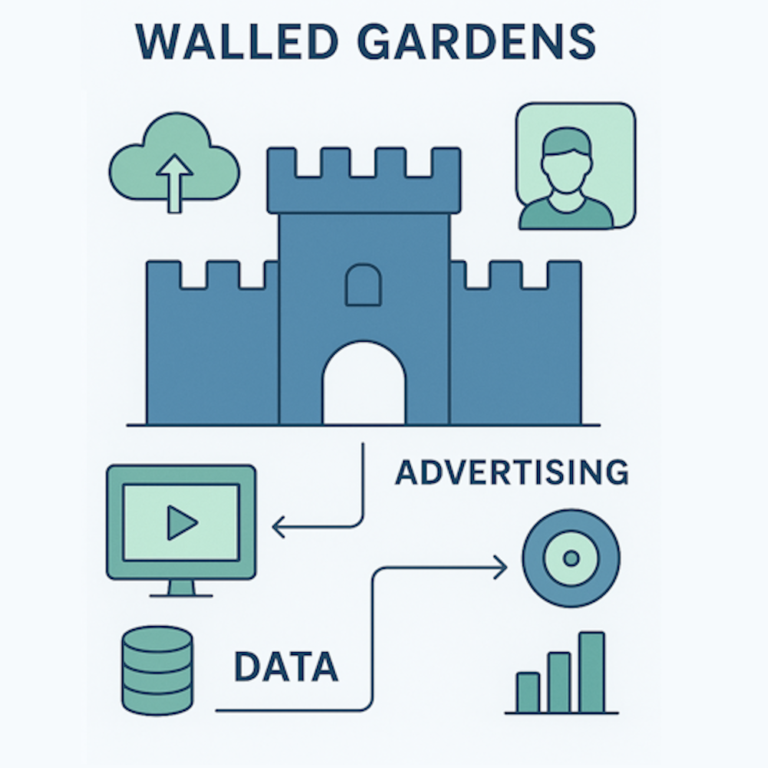
‘Walled gardens’ refer to closed digital ecosystems operated by major tech providers such as Google, Meta Platforms and Amazon. Within these environments, content, user data and advertising space are completely controlled. External partners do not have direct access to sensitive customer data, but can still display targeted advertising within the system.
Outlook: Shaping rather than reacting
The adtech industry will once again reach a turning point in 2026. Identity, AI, attention and regulation are the cornerstones of this dynamically evolving market. Those who see this phase as an opportunity can help shape tomorrow’s standards today, whether through data protection-compliant partnerships, well-thought-out technology integration or a clear stance on transparency and innovation.
The coming months will show whether the industry will succeed in translating complexity into scaling and fragmentation into cooperation. One thing is certain: future security arises where technology, strategy and responsibility are not separated, but consciously considered together. Those who master this triad can not only react, but also shape the future.