There is broad consensus within the media industry as to the direction in which moving images are heading: in future, linear television, connected TV and streaming should no longer be planned in isolation, but should function as a shared advertising ecosystem. There is now widespread agreement on this within the market. At the same time, the existing model of separate categories is increasingly reaching its limits. Rising operational costs, changing viewer behaviour and growing demands from the buy-side are increasing the pressure to integrate these previously separate worlds more closely.
What is therefore still under discussion is not so much the goal as the path to achieving it: what technological infrastructure is needed to make Total TV a reality in day-to-day operations?
Max Deyerl, Business Development Manager at Virtual Minds, is exploring this question. In his view, the success of Total TV will not depend on new concepts, but on the technological foundation that will enable linear and digital advertising worlds to work together in future. “The real challenge today is no longer to define the objective, but to create the necessary infrastructure to achieve it,” he explains.
Why the existing model is reaching its limits
Why is a new model for video marketing needed at all? The answer lies not so much in a single technological development as in several changes that are simultaneously affecting the market.
Economic pressure: The existing model, organised on a channel-by-channel basis, generates avoidable inefficiencies. Separate bookings, manual interfaces and the subsequent consolidation of campaign data result in additional effort and sources of error. This increases operational costs for broadcasters and advertisers, whilst the buy-side is faced with more complex planning processes.
Changing viewer behaviour: Viewers have long been consuming moving images across various channels and screens. They switch between linear television, connected TV and streaming without distinguishing between the different formats. For them, it is the viewing experience that counts, not the channel. However, marketing has so far failed to adequately reflect this behaviour and is still often organised into separate structures.
Competitive pressure: On the buy-side, too, the demands for simple, transparent and data-driven planning of video campaigns are increasing. Granular control and automated processes have long been the norm in the digital sector. The more these expectations spread across the entire video market, the more important it becomes to efficiently integrate separate inventories and processes. Fragmented structures are therefore increasingly becoming a competitive disadvantage.
Artificial intelligence as a catalyst: As the use of AI increases, so too does the pressure to interconnect systems and data more closely. Cross-domain analysis and automated optimisation can only function on the basis of consistent data. Where different systems and logics do not work together, AI can not only perpetuate existing distortions but also exacerbate them.
These developments make it clear that a new model for Total TV is necessary not merely because technology is evolving. Structural change is needed because usage patterns, buy-side requirements and economic pressures have already shifted. The crucial question is therefore no longer whether moving-image genres need to converge more closely, but how this convergence can be implemented operationally.
The future of Total TV does not lie in standardising existing channels, but in enabling them to work together intelligently.
Max Deyerl, Business Development Manager Virtual Minds
Convergence requires a shared infrastructure
But what does ‘convergence’ mean in this context? It does not mean that the various moving-image channels lose their distinctive characteristics. Whilst linear television, connected TV and streaming are becoming increasingly intertwined because they share content, screens and target audiences, they continue to differ in terms of their level of maturity, measurement methods, currencies and business models. The aim should therefore not be to replace all existing systems with a single platform. Rather, it is a matter of intelligently connecting these worlds with one another.
From Max Deyerl’s point of view, the real problem therefore lies not in the diversity of the systems, but in their lack of interconnectivity: “What is missing is a common technological basis on which these approaches can work together. For it is only when the services of different market players become interoperable that the potential arises to offer European media companies a genuine alternative to the globally integrated streaming platforms.”
This is where the concept of a convergence layer comes in. As an interoperable infrastructure, it connects existing linear and digital systems, thereby laying the foundations for cross-channel campaigns without compromising the respective strengths of the individual systems.
The path to a genuine Total TV campaign
However, an interoperable infrastructure is not an end in itself. Its true added value lies in campaign management. Total TV’s vision is to plan, manage and continuously optimise campaigns across all channels based on a shared approach. It makes no difference whether an advertising touchpoint occurs on linear television, via Connected TV or on a streaming platform.
“The future of Total TV does not lie in standardising existing channels, but in enabling them to work together intelligently. Only when planning, management and optimisation are based on a shared infrastructure across all channels will individual bookings become a truly integrated campaign,” explains Max Deyerl.
This is where the Virtual Minds Media Manager comes in. As an interoperable layer between existing linear and digital systems, it lays the groundwork for intelligently connecting existing technologies and efficiently managing cross-channel campaigns.
Austria shows how convergence can be achieved step by step
A look at Austria shows how the path towards an interoperable infrastructure can be gradually put into practice. There, the broadcasters and marketing organisations within the AGTT have been using the Virtual Minds Media Manager as a common technological platform since 2024 to manage linear TV advertising in a more data-driven and flexible manner.
The focus here is on TV Load – an approach to the dynamic, real-time optimisation of advertising blocks in linear television. Instead of relying solely on forecast-based advance planning, advertising blocks are continuously recalculated on the basis of up-to-date Teletest 2.0 data. In doing so, the Virtual Minds Media Manager takes into account, amongst other things, actual audience trends and defined reach targets. In this way, digital KPIs and data-driven control logic are increasingly being integrated into linear TV marketing.
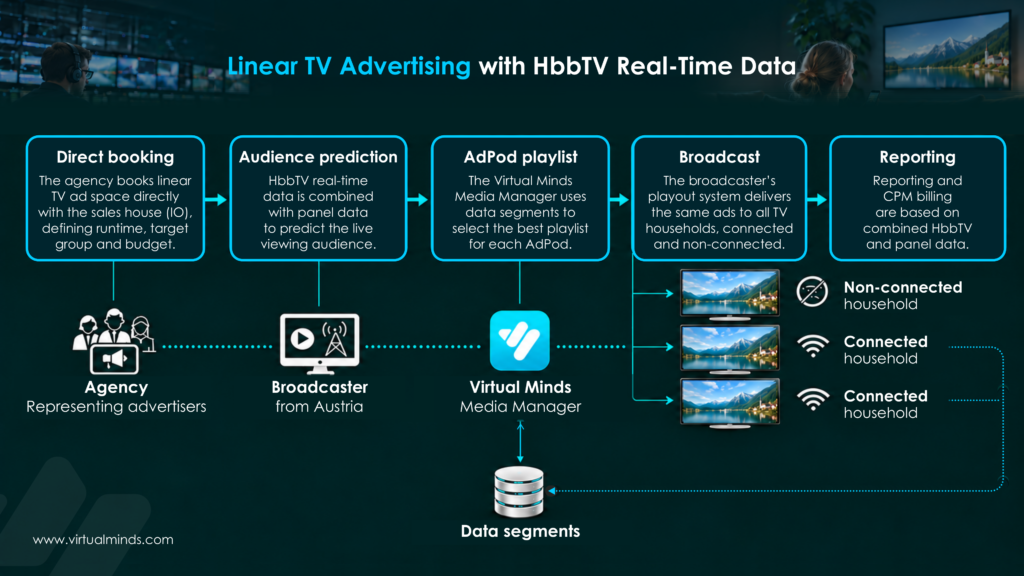
This example thus illustrates how convergence can arise in practice: the two sectors are moving towards each other in both directions. Whilst Connected TV is increasingly adopting the standards and structures of linear television, digital logic is also finding its way into traditional TV. Automated planning, data-driven delivery and optimisation during an ongoing campaign are increasingly replacing processes that were previously more manual in nature.
This is not simply a matter of applying digital metrics or trading models to linear TV. What is crucial, rather, is that the underlying processes also change. A common currency can provide an important framework for this, but its true added value only emerges when planning, execution and optimisation are also carried out in a data-driven and automated manner. For example, anyone who trades linear inventory on a CPM basis but continues to plan and schedule campaigns manually has ultimately just changed the price tag, not the way they work.
For Max Deyerl, the Austrian example shows that a fully harmonised market is not the key factor here. Rather, the crucial thing is to integrate existing technologies in such a way as to enable shared processes.
This use case is not a ready-made blueprint for a fully converged market. Rather, it demonstrates how shared infrastructure, interoperable technologies and close cooperation between broadcasters and content providers can enable the first operational steps towards Total TV. It is precisely this step-by-step approach that is likely to set the direction for other European markets as well.
Scaling will determine the future of Total TV
This demonstrates how the technological foundations for Total TV can be laid step by step. The crucial question now is how these structures can be scaled across markets and organisations. In future, it will be essential to establish them beyond individual channels and genres. For it is only when systems communicate with one another and enable shared processes that reach can be efficiently pooled and campaigns managed across channels.
This presents a strategic opportunity, particularly for European broadcasters and marketers. A shared technological foundation can help to better connect fragmented inventory, market it more efficiently and tap into new monetisation potential, thereby creating a powerful alternative to the closed ecosystems of international platforms.
For Max Deyerl, therefore, the focus is not on developing further individual technologies, but on their ability to work together: “The vision for Total TV was set out some time ago. The task now is to translate it into scalable processes. Convergence does not arise from new buzzwords, but from technologies that enable interoperability.”
Whether European broadcasters and marketers can secure their long-term competitiveness will therefore depend largely on how consistently interoperable infrastructures are established and scaled across market boundaries. After all, the more data-driven automation and AI shape campaign management, the less fragmentation can be viewed as a purely operational challenge. Those who fail to break down technical silos risk not only higher costs and less efficient processes, but also the risk that automated systems will optimise on the basis of incomplete data.
Total TV therefore needs more than just a shared vision. It needs an infrastructure that turns separate genres into a single, scalable process.